
Most vehicle decisions are settled before taste enters the conversation. How many people are travelling, how much luggage are they carrying, what kind of occasion is it, and what does the route actually demand? Answer those four questions and the right class is usually obvious.
This guide works through all four, from the routine airport run to the set-piece arrival, for journeys across Manchester, the North West and nationwide. Seat counts and boot capacity for every class are listed on our fleet page if you want to cross-check as you plan.
Already know your passenger and luggage numbers? Request a quote and we will confirm the right class.
Start with passengers and luggage
Capacity is the first constraint and the one people most often misjudge. If the boot is too small, someone ends up travelling with a suitcase on their lap.
Up to three passengers and three cases: the executive saloon
For a solo traveller, a pair or a party of three, an executive saloon is the efficient choice. The Mercedes E-Class takes up to 3 passengers and 3 cases.
Once the party grows past three, or the luggage past three cases, it is time to size up.
Three to seven passengers, multiple cases: the Mercedes V-Class
Once you are travelling as a small team, or a client arrives with several large cases, the V-Class is the right capacity. It seats up to seven with a configurable cabin and dedicated luggage space behind the rear row, so a group of four or five travels with a full set of suitcases rather than holding bags on laps.
The conversational seating suits a team that wants to talk en route, and a single vehicle keeps everyone together rather than splitting across two saloons. For airport collections of a small delegation with checked baggage, this is usually the practical answer.
Up to eight passengers, full luggage: the VIP Sprinter
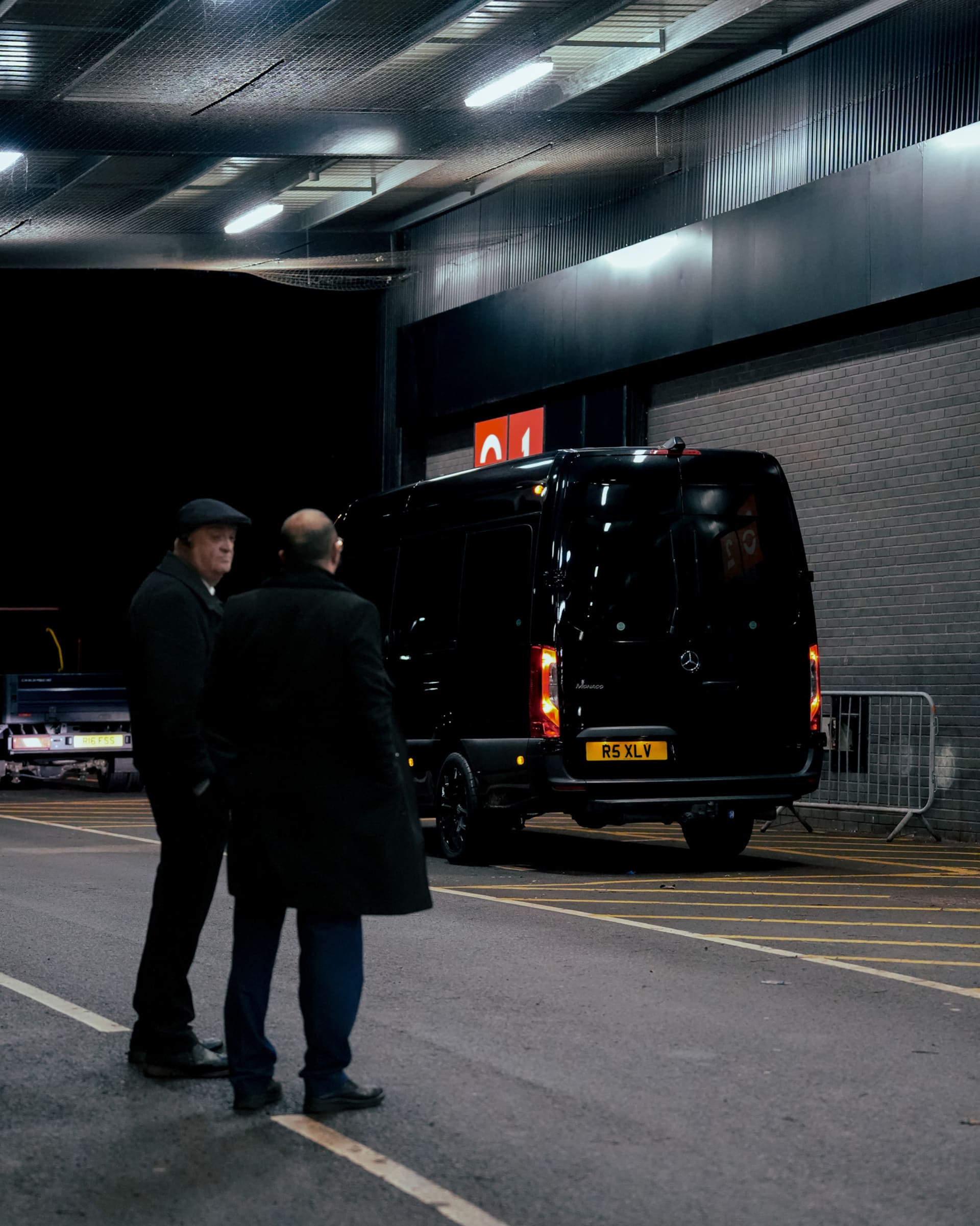
For a whole team, a delegation or a conference group, the VIP Sprinter carries up to eight passengers in individual captain seats, with climate control and room for 12 cases.
Much of the advantage is logistical: with one vehicle and one chauffeur, the whole group arrives at the same time. When counting heads for an airport run, count the checked luggage too, because eight passengers travelling for several days will use all 12 cases of space.
Then consider the occasion
For some journeys, how the car looks matters. An awards evening, a board dinner, collecting an investor, or hosting a senior client through a day of meetings. On those occasions the guest sees the car before they have spoken to anyone.
The Range Rover leads on presence. For an awards evening, a gala, or any occasion with a sense of arrival, it reads well at a venue entrance and suits a principal who wants to be seen to have arrived properly.
The VIP Sprinter and V-Class handle hosted groups. When a delegation or a leadership team is travelling together, keeping everyone in one cabin lets the group travel, talk and arrive together.
The regular traveller: consistency over novelty
If you travel for work most weeks, the vehicle matters less for show than for what it lets you do on the move: take a call, read a brief, and use the half hour to the airport as working time.
An E-Class suits the routine city-to-airport journey or a run between regional offices.
If you are in a car several times a week, legroom, supportive seats and a quiet cabin add up, and you finish the week less tired.
Let the route inform the choice
Around Manchester, the vehicle question is partly a local one. Routes here fall into two broad shapes and the choice should suit both.
Within the city, short transfers between venues around Deansgate, Manchester Central and the Peter Street hotels reward a discreet saloon that handles tight streets and kerbside collections cleanly. The longer legs are defined by the motorway network: the M60 orbital and the M56 down to the airport and Cheshire.
The Manchester Airport run has two awkward ends. Early flights mean collections across Greater Manchester at unsociable hours, and a return often lands into the evening rush, so flight tracking and reliability matter as much as the vehicle. We track the flight on every pickup booked through our airport transfer service.
Setting a standard: vehicles in a corporate travel policy
A travel policy is a standard you set once and apply consistently. Costs become predictable, and a client or a colleague gets the same standard of car whether they travel with you weekly or twice a year.
The E-Class makes a sensible everyday default for individual travellers. Capacity tiers sit within the same policy: a V-Class for a board travelling to a regional event, a VIP Sprinter for conferences or team away-days of up to eight. Setting these defaults removes ad-hoc decisions and controls spend.
A programme also needs the billing in one place. Approved R5 accounts get one VAT invoice a month, so finance can reconcile travel without chasing individual receipts. Our corporate chauffeur service page sets out how that account works.
Movements that need more than one vehicle
Some journeys do not fit a single vehicle: a board arriving on different flights, or a group too large for one Sprinter. The planning question is how to split the party by both seats and cases. Pairing a saloon for senior arrivals with a V-Class for the wider team works well, as does running two Sprinters for a sizeable conference.
R5 coordinates multiple vehicles to one schedule, so a group spread across several cars still moves as one. Where luggage is heavy or awkward, whether production kit, exhibition stands or sports equipment, flag it at the time of booking so we allocate boot space rather than seats alone.
Frequently asked questions
Which executive vehicle is right for an airport transfer?
For one or two passengers with a case each, an E-Class saloon is enough. For three to seven passengers with checked baggage, the V-Class is usually the practical choice because luggage rather than seating is the limiting factor. A group of eight with full luggage needs the VIP Sprinter, and a larger group needs more than one vehicle.
How many passengers does a Mercedes V-Class seat?
Up to seven, with dedicated luggage space behind the rear row. In practice a party of four to five travels most comfortably in a V-Class when everyone has a full-size suitcase.
Can you carry a group of eight in one vehicle?
Yes. The VIP Sprinter seats up to eight in individual captain seats. Bear in mind that eight passengers travelling for several days will use the full boot capacity, so tell us the luggage count as well as the headcount and we will confirm whether one vehicle is sufficient.
How do we set vehicle standards for a company travel policy?
Most organisations agree a default class for individual travellers, a senior tier for board-level and client-facing journeys, and capacity tiers for group movements. R5 can help set those defaults and put them on a managed account with consolidated monthly billing.
Tell us your passenger and luggage numbers and we will confirm the right class.
Get a quote